


Case sharing

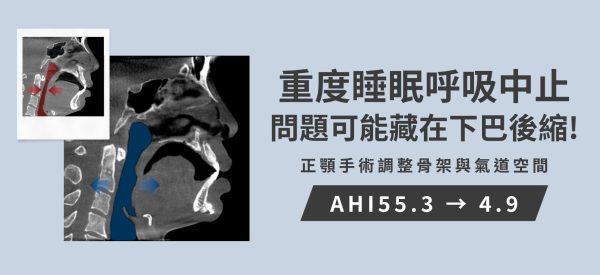
This patient, suffering from severe sleep apnea and persistent snoring and daytime sleepiness, was found to have a receding jaw and airway narrowing upon examination. This article documents the changes in his CT scans, airway space, and sleep monitoring before and after orthognathic surgery…

A 26-year-old male with an AHI of only 7.9 suffered from severe snoring, daytime sleepiness, and lethargy. 3D CT scans revealed a receding jaw, short face, and narrow airway. Through a combination of invisible braces and MMA maxillofacial repositioning surgery, airway space, deep bite, occlusion, and lower facial proportions were simultaneously improved. This case demonstrates that mild sleep apnea cannot be diagnosed solely based on AHI.
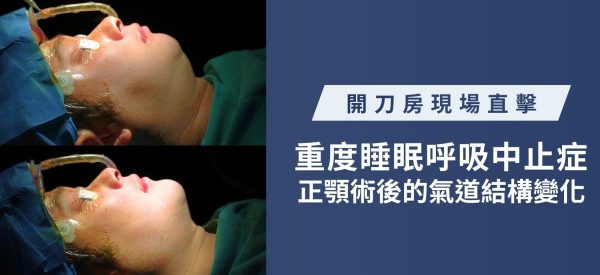
Why might a receding chin cause breathing difficulties while sleeping? This article takes you inside the operating room, from pre- and post-operative images and 3D digital surgical planning to CT scans, to understand the relationship between a receding chin and airway narrowing, and how MMA orthognathic surgery increases airway space by moving the jawbone forward.
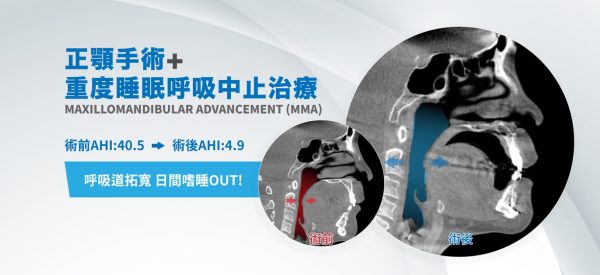
This 50-year-old woman suffered from severe sleep apnea (AHI = 40.5), with symptoms including severe daytime sleepiness (ESS = 17) and annoying snoring. Interestingly, a CT scan revealed that, in addition to the expected narrowing of her airways, she had undergone a Wassmund and Kole procedure in her youth. This procedure involves extracting one premolar from each side of her upper and lower jaws, then repositioning the upper and lower jaws through bone cutting to correct a protruding mouth.

Orthognathic surgery was originally designed to improve the bite and appearance of the patient. However, in the field of treating obstructive sleep apnea, orthognathic surgery (maxillo-mandibular advancement/MMA) has become a means to tighten the collapsed (relaxed) muscles rather than an end. Improvement in appearance and bite has become an added value of maxillo-mandibular advancement.
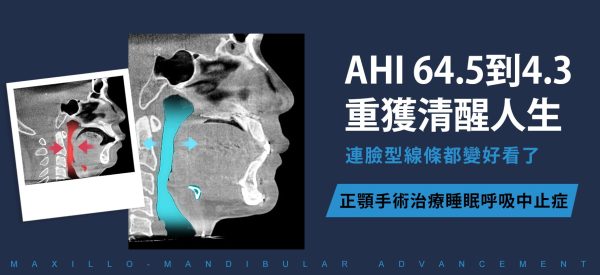
This is a patient with extreme sleepiness. His Epworth Sleepiness Scale score is 17. If the score is over 10, it is considered to have reached the level of sleepiness that requires medical intervention. The sleep report he brought from the hospital showed that his AHI was as high as 64.5 (AHI>30 is severe sleep apnea) and his lowest blood oxygen level reached 60%. For patients with retruded mandible and severe sleep apnea, orthognathic surgery (Maxillo-Mandibular Advancement, MMA) should be one of the priority treatment options, especially since this patient is completely unable to accept having to wear a positive pressure ventilator for a long time. The CT scan after the operation showed that the narrow and blocked airway had been widened and supported through the reorganization of the upper and lower jaws. At the same time, the face shape, jaw line, tooth angle and bite state also benefited from the orthognathic surgery. Most importantly, the postoperative sleep report showed that the AHI had dropped to 4.3, which is the same as the normal standard, and the minimum blood oxygen level had increased to 83%. Subjectively, in addition to greatly reducing snoring, he felt much more energetic during the day and was not sleepy.
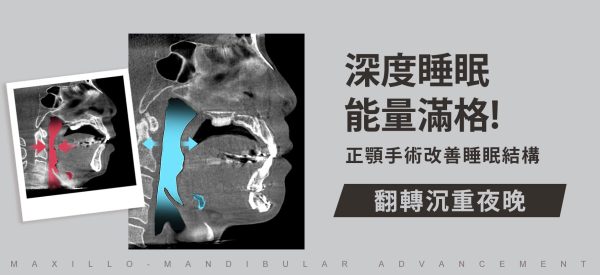
A very sleepy patient came to see a doctor with a sleep report. The report showed that he had severe sleep apnea (AHI = 31.4 /hr). Due to the long-term lack of rapid eye movement (REM) sleep, he also developed clinical symptoms such as bad mood, memory deterioration and cognitive dysfunction. Over the years, he has tried positive pressure respirators and anti-snoring mouthpieces, but in recent years he has found it increasingly difficult to adapt to them. He would remove these breathing aids himself during sleep, which naturally had no therapeutic effect, so he hoped to seek more radical surgical treatment. We performed Maxillo-Mandibular Advancement (MMA) to widen his airway. From the CT scan, we can see the location of the obstruction (the suspensory part and the tongue root), which was well opened and widened. The position of the hyoid bone was obviously lifted upward and forward. The postoperative sleep report showed that the sleep apnea index (AHI) dropped from 31.4/hr to 7.5/hr, the minimum blood oxygen concentration increased from 80% to 89%, and the sleep structure was closer to that of healthy individuals. In principle, the treatment goal should be to reduce light sleep N2 and increase deep sleep N3 and the proportion of rapid eye movement (REM). Light sleep N2 dropped from 72.4% to 55.7% (N2 of a healthy individual should account for 55%), deep sleep N3 increased from 9.4% to 12.1% (N3 of a healthy individual should account for 15%), and most importantly, rapid eye movement (REM) increased from 9.4% to 24.8% (REM of a healthy individual should account for 25%). Because of the increase in deep sleep, the patient felt more well-rested and recharged after the operation, his mood was more positive, and he had more energy in life and work.

This patient had undergone orthodontic treatment with tooth extraction before, but later she found that the problems and concerns she had far exceeded whether her teeth were straight. This time she was referred to our center by a sleep specialist dentist, mainly to solve her severe daytime sleepiness and snoring problems during sleep. After a sleep test, she was diagnosed with moderate sleep apnea (AHI=19.4). CT also showed that her airway stenosis was caused by severe retraction of the mandible, which compressed the posterior airway space. Taking into account her obvious symptoms of sleep apnea (sleepiness, snoring), the cause (narrow bones, lack of space), and her expectations for appearance and occlusion, we designed an orthognathic surgery (MMA: maxillo-mandibular advancement) for her, which would widen her airway and improve her appearance and occlusion. Postoperative orthodontic treatment was performed by the referring physician using Invisilign. The sleep test result six months after the operation was AHI=1.4, which has returned to normal. The symptoms of snoring and sleepiness have disappeared, and she also likes the way she looks after the operation more.
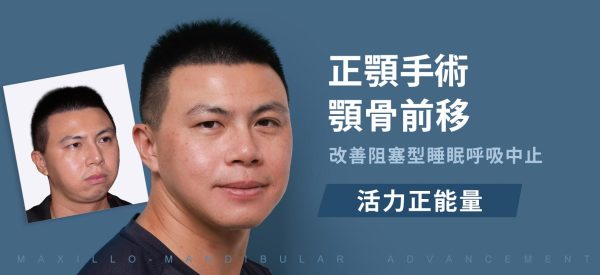
Orthognathic surgery was originally designed to improve the bite and appearance of the patient. However, in the field of treating obstructive sleep apnea, orthognathic surgery (maxillo-mandibular advancement/MMA) has become a means to tighten the collapsed (relaxed) muscles rather than an end. Improvement in appearance and bite has become an added value of maxillo-mandibular advancement.

A young man was troubled by severe obstructive sleep apnea (OSA), with an AHI index as high as 55.8, and symptoms such as loud snoring, daytime sleepiness, headaches, and difficulty concentrating. Because he was unwilling to use a positive-pressure respirator, he underwent mandibular advancement surgery (MMA) combined with chin advancement surgery to successfully expand the airway space. The AHI dropped to 3.9 6 months after the operation, and his symptoms were significantly improved. This case demonstrates the therapeutic effect of MMA surgery on patients with severe OSA, providing patients with a treatment option that does not require respirators.