


Post-orthognathic surgery recovery exercises – Feng Hua teaches you how!
1.Mouth opening exercisesImproves limited mouth opening
2.Massage for relaxing the masticatory musclesRelieves swelling and tightness
3.Lip and facial expression exercises Improves muscle elasticity and facial expression
These exercises not only helpPromotes blood circulation and reduces muscle stiffness, canPrevent joint adhesionsThis ensures the stability of the facial shape and the recovery of function after surgery.
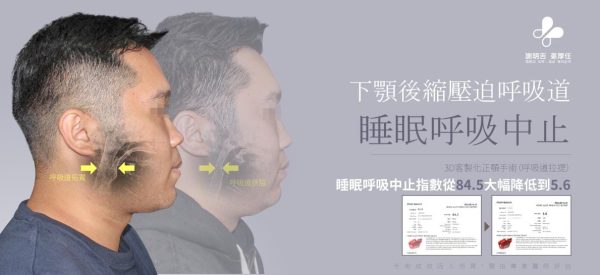
Recommended clinic for sleep apnea in Taipei - Feng Hua United Clinic
In this articleFenghua United ClinicWill explore in depthNecessity of exercise after orthognathic surgery, appropriate timing and method of exercise, and precautions, helping patients to conduct rehabilitation safely and effectively under professional guidance and achieve the best postoperative results.
What is orthognathic exercise?
"Orthognathic exercises" refer to the exercises performed after orthognathic surgery.A series of rehabilitation exercises targeting the jaw, facial muscles, and joints.This process promotes tissue healing, restores function, and stabilizes facial shape.

Orthognathic surgeryback,Patients often face problems such as muscle stiffness and joint tightness.This is because the manipulation of the jawbone and surrounding tissues during surgery may obstruct local blood circulation, leading to tissue swelling and increased muscle tension.
In addition, postoperative pain and discomfort may cause patients to unconsciously reduce facial movements, further aggravating muscle and joint stiffness.
The following are the advantages of orthognathic movements:
- Improve blood circulation: Accelerate the healing of the surgical site and reduce swelling and bruising.
- Restore muscle elasticity and joint mobility: Prevent muscle stiffness and joint adhesion, and avoid difficulty in opening the mouth.
- Maintain and improve occlusal function: Ensure normal functioning of daily functions such as chewing and speaking.
- Stabilize the facial shape after surgery: Prevent facial asymmetry caused by muscle imbalance.
For patients, orthognathic exercises are an important part of postoperative recovery, which not only helps with physical recovery but also improves patients' psychological comfort and self-confidence.
What is the relationship between orthognathic exercise and postoperative recovery?
Orthognathic movement plays a key role in postoperative recovery, which is mainly reflected in the following aspects:
- Improve blood circulation: Exercise can increase blood flow to the surgical area, provide sufficient oxygen and nutrients, and promote tissue repair.
- Reduce tissue adhesion: Regular and appropriate joint and muscle exercise can prevent adhesion between tissues and maintain tissue flexibility.
- Avoid difficulty opening your mouth: Maintain joint flexibility and prevent mouth opening restriction through mouth opening exercises and chewing exercises.
- Improve nerve function recovery: Exercise stimulation can promote nerve regeneration and help restore sensory and motor functions.
In short, orthognathic exercise is an indispensable part of postoperative recovery, which can effectively improve surgical results and ensure that patients can resume normal life functions.
What are the common post-operative orthognathic rehabilitation exercises?
Orthognathic surgeryRecovery after an injury not only relies on natural healing, but also requires active and correct exercise training to help muscles regain mobility and coordination.
The following are some common and practical postoperative jaw exercises, each of which can be performed according to the doctor's instructions during the postoperative stabilization period:

Mouth opening exercises
Mouth opening exercises can helpImprove the opening restriction situation
- Initially, you can use clean fingers to gently open your upper and lower jaws, holding each position for 5-10 seconds, gradually increasing the number of fingers used.
- You can also use a tongue depressor trainer (such as a simple tongue depressor stacking tool) to practice steadily. It is recommended to practice 2-3 times a day, for about 5-10 minutes each time.
Massage for relaxing the masticatory muscles
Postoperative discomfort caused by swelling and tightness of the masticatory muscles can be relieved by gentle self-massage.
- Use your fingertips to massage the muscles below the cheekbones and at the angle of the jaw in a circular motion, avoiding excessive pulling of the skin. Continue for about 1 to 2 minutes in each area.
- Can be used with hot compress (recommended below 40 degrees) for better effect, helps blood circulation and reduces muscle fatigue.
Lip and facial expression exercises
After surgery, some patients may experienceStiff face or unnatural expressions, it is recommended toStretching and Activation Exercises for Facial Expression Muscles.
- For example, makeSmiling, pouting, puffing out cheeks, raising eyebrowsPerform each expression for 3-5 seconds, repeating 5-10 times daily.
- This type of exercise helps improve muscle elasticity and facial coordination.
Each patient's recovery situation is different and must be evaluated by professional medical personnel. The rehabilitation plan should be customized and carried out under the guidance of professional medical personnel.
When can I start exercising after orthognathic surgery?
Post-orthognathic surgery exercise should be based on the post-operative time and individual recovery progress.Phased:
The first week after surgery: rest and appropriate ice and hot compresses
During the first three days after surgery, the patient should get enough rest and apply ice, and avoid exercising too early to prevent bleeding and swelling. On the fourth day, hot compresses should be applied to help eliminate swelling (each case is different and the doctor's instructions must be followed).
Key points of this phase include:
- Ice: 15-20 minutes each time to prevent further swelling and relieve pain.
- Keep your head elevatedSleeping with your head elevated can help reduce swelling and make breathing easier.
- Avoid strenuous activity: Prevent wounds from opening or bleeding.
2-4 weeks after surgery: Start mild mouth opening exercises
After the doctor assesses that the wound is healing well, you can start with gentle mouth-opening exercises to gradually restore the range of motion of the joint:
- Mouth opening exercises: 5-10 times a day, open your mouth for about 15 seconds each time, and gradually increase the width of your mouth opening.
- Jaw movement training: Move slightly left and right, front and back to promote muscle coordination.
- Avoid excessive exertion: Exercise should be performed within the pain-free range to avoid pulling the wound.
More than 1 month after surgery: Perform functional exercises according to the doctor's instructions
One month after surgery, patients can perform further functional exercises under the guidance of a physician to restore facial functions required for daily life:
- Chewing training: Start with soft foods and gradually return to a normal diet.
- Facial muscle exercise: Actions such as smiling and frowning promote the flexibility of facial muscles.
- Pronunciation Practice: Gradually restore normal speaking ability.
Each patient's recovery situation is different, and the exercise plan should be customized and carried out under the guidance of a professional medical staff.
What precautions should be taken when exercising after surgery?
Although postoperative exercise is very helpful for recovery, it may have adverse effects if done in the wrong way or at the wrong time.
The following are the key points to pay special attention to when doing rehabilitation exercises after orthognathic surgery:
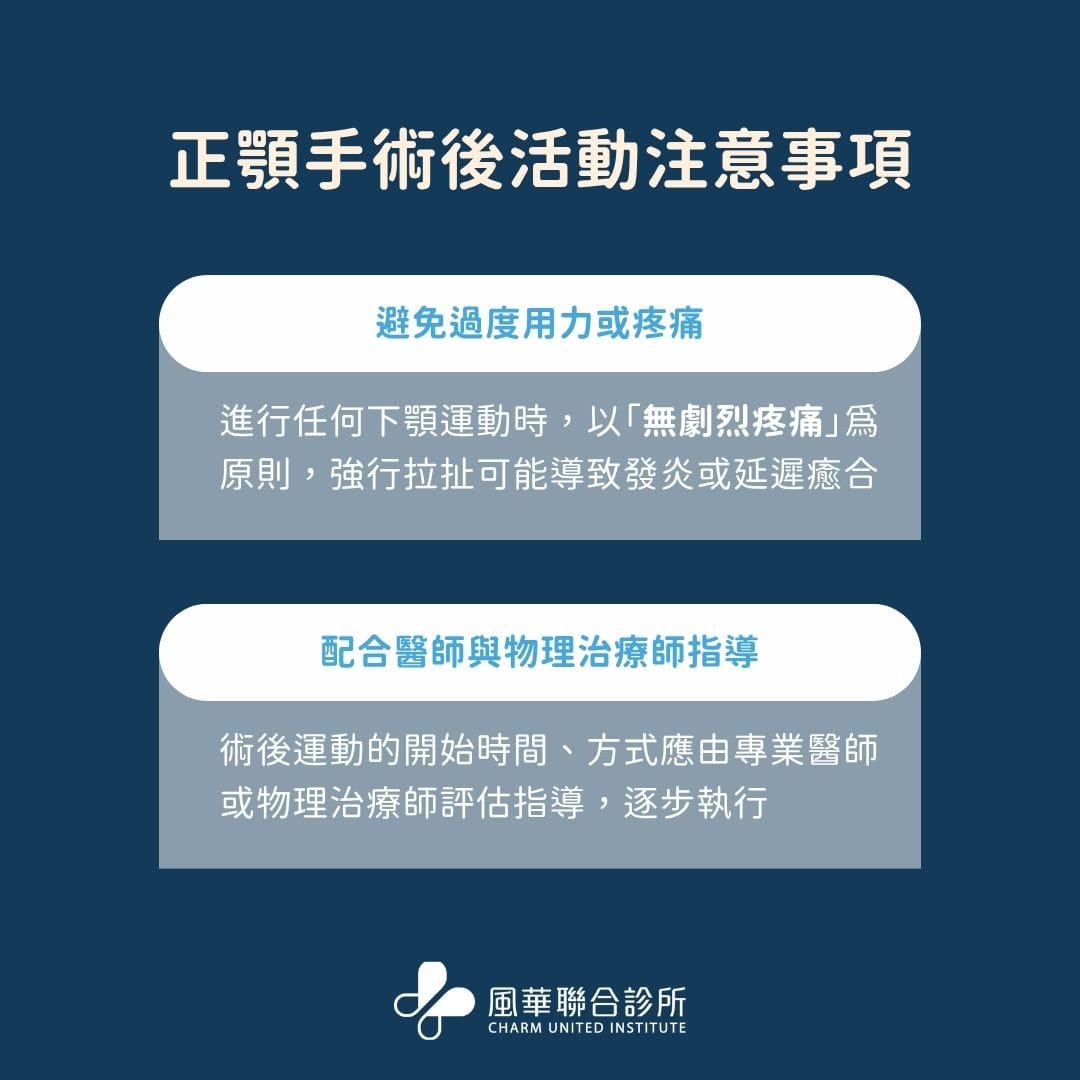
Avoid excessive exertion or pain
- When performing any jaw movement,No severe pain" is the principle.
- In the early postoperative period, the joints and tissues are still sensitive, and forced pulling may cause inflammation or delayed healing.
Under the guidance of doctors and physical therapists
Each patient's recovery and the extent of surgery are different.The time and method of postoperative exercise should be determined by the physician or physical therapist after evaluation.. Do not act on your own based on information on the Internet; instead, follow professional guidance step by step to ensure safety and effectiveness.
How to arrange exercise frequency and time?
- suggestionIn the initial stage, perform rehabilitation exercises 2 to 3 times a day, each time for about 5 to 10 minutes..
It can be done in the morning when you wake up, after lunch, and before going to bed. It is not only easy to develop a habit, but also allows you to observe the muscle reaction after the day's activities and adjust the exercise intensity in time.
What happens if you do too little rehabilitation exercise after orthognathic surgery?
Postoperative rehabilitation exercises are not optional. If ignored for a long time, it may affect the surgical results and quality of life.
The following are some common after-effects:
Can’t open the mouth or face shape is asymmetrical
Lack of proper exercise can lead toLimited opening (Trismus),In the long term, even normal eating and brushing may be affected.
In addition, if muscle recovery is uneven,The face is prone to be skewed or asymmetrical, which in turn affects appearance confidence and psychological state.
Unstable bite or increased risk of recurrence
Orthognathic surgery reshapes the bone structure. If you do not use exercise to help your muscles and joints establish a new balance after surgery, it mayLeading to unstable bite and even the risk of recurrence of malocclusion.
Therefore, postoperative rehabilitation can be regarded as an important part of consolidating surgical results.
What auxiliary tools can be used with orthognathic exercises?
In addition to freehand exercises, you can also use various auxiliary tools to improve training effects and comfort:
Corrective rubber bands or tension strips
Some patients still need to wear corrective devices, such as corrective rubber bands, after surgeryHelps stabilize and control the jaw, helping muscles adapt to new positions.
However, the method of use must be in accordance with the instructions of the orthopedic physician to avoid misuse that may cause asymmetry or tension imbalance.
The timing of ice and heat
After surgeryIce compress is recommended for the first three daysControl swelling,15 to 20 minutes each time, multiple times a day;Starting from the fourth day, you can use hot compresses instead.Promotes blood flow and muscle flexibility.
Do not alternate between hot and cold compresses, as this may cause more swelling and discomfort.
In addition to post-operative exercise after orthognathic surgery, what else should I pay attention to during the recovery period?
Comprehensive postoperative care cannot ignore the following points to ensure surgical effectiveness and quality of life:
- Dietary modification: It is recommended to eat liquid food and then soft food in the early postoperative period to avoid hard food causing pressure on the jaw. You can gradually resume normal diet according to the doctor's advice.
- Oral hygiene maintenance: Keeping the surgical area clean helps prevent infection. Use mouthwash (without alcohol), a small-sized soft-bristled toothbrush head, and a mild toothpaste to clean your mouth, preferably after each meal and before going to bed.
- Regular follow-up:Follow the follow-up visit plan arranged by the doctor, evaluate the occlusal stability and recovery progress, and adjust the rehabilitation plan if necessary.
Further reading:
- What should I do if my orthognathic surgery fails? dcard netizens share how to avoid orthognathic surgery failure and regret
- Why do patients with apnea eventually choose orthognathic surgery? Orthognathic surgery conditions and symptom improvement in one visit
- Jaw straightening and swelling reduction is fast and accurate! Uncover the ways to accelerate jaw swelling reduction and common problems, say goodbye to swollen face!