


Sleep apnea: snoring who had to sleep in a separate room with his girlfriend

The operating room at Feng Hua Joint Clinic is equipped with surgical lights and anesthesia machines.
The main visual of a patient undergoing orthognathic surgery for snoring shows receding chin and mandibular bones.
Preoperative symptomssurgical plan
Sleep apnea chin and mandibular retraction3D customized orthognathic surgery chin advancement surgery

postoperative changes

The patient with sleep apnea returned for a follow-up visit six months after the operation. He said that the happiest thing was that his girlfriend no longer complained about his snoring and allowed him not to be assigned a room. Being handsome is really just added value.

Appearance changes

Before and after frontal appearance comparison of orthognathic surgery
Before and after orthognathic surgery: frontal smile appearance comparison
Comparison of 45-degree bevel appearance before and after orthognathic surgery
Comparison of 45-degree angled smile appearance before and after orthognathic surgery
Comparison of chin and neck lines before and after orthognathic surgery

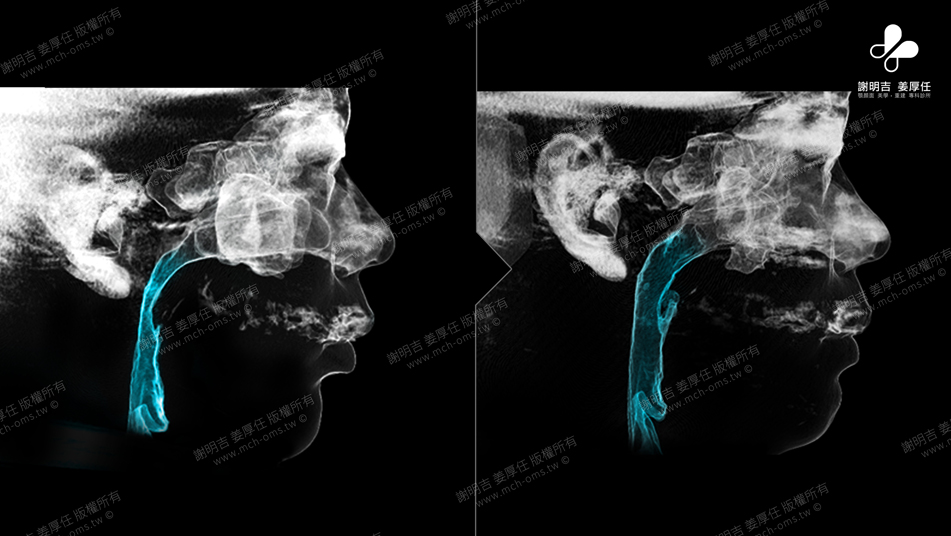
Comparison of tomography before and after surgery

Before and after orthognathic surgery, CT scans show postoperative widening of the airway, indicated by blue.
Three-dimensional images of the airway before and after orthognathic surgery show increased airway space postoperatively.

Warm reminder

  1. Please follow the instructions of the doctor and nursing staff, take medicine regularly, pay attention to dietary taboos and keep the wound clean.
  2. There may be complications such as bleeding, infection, inflammation, etc. after surgery. The degree will vary according to individual physical differences, so careful care is required. If the above situations occur, please contact us as soon as possible.
  3. It is normal for 3 to 6 months after surgery to experience temporary slow sensation and unnatural expressions at the surgical site. Through independent massage and facial expression exercises, most patients will gradually improve within 6 to 12 months after surgery.
  4. Anesthesia has certain risks, which are related to the patient's own physical condition. Patients must honestly and clearly report their health status and treatment history to the treating physician and anesthesiologist, and do not hide anything.
  5. It is recommended to communicate with the doctor before surgery and clearly express treatment needs. However, the aesthetic appearance after surgery is subjective and should not be used as a basis for judgment of surgical results.
  6. The results of surgery vary from person to person and need to be evaluated by a professional physician. Case pictures are publicly used with the authorization of the parties involved as auxiliary explanations of diagnosis and treatment, health education and medical knowledge sharing, and are for reference only.