


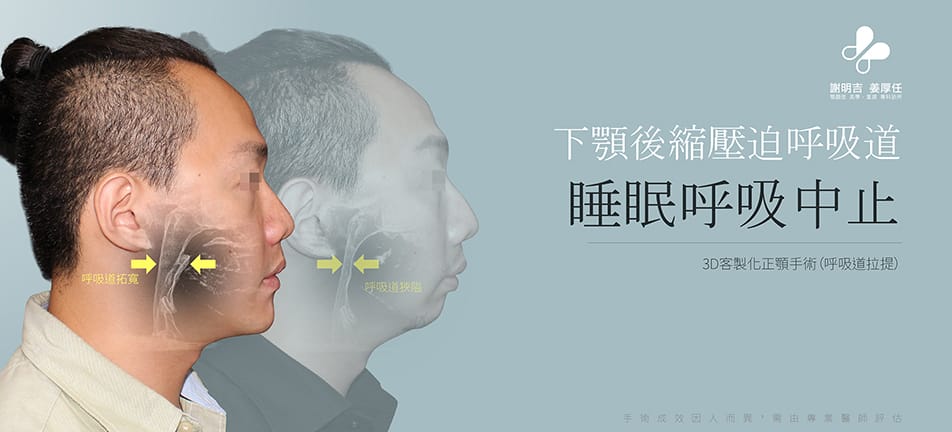
Orthognathic surgery opens the airway and says goodbye to daytime sleepiness

The operating room at Feng Hua Joint Clinic is equipped with surgical lights and anesthesia machines.
Comparison of facial profile and airway widening before and after 3D customized orthognathic surgery for patients with daytime sleepiness
Preoperative symptomssurgical plan
Retruded jaw, no chin affecting airway space, sleep apnea3D customized orthognathic surgery

postoperative changes

Dr. Xie Mingji|3D Customized Orthognathic Surgery|Sleep Apnea

Diagnosis and treatment plan and postoperative changes

"Mandibular advancement" in orthognathic surgery has been proven to be one of the effective treatments for obstructive sleep apnea. By moving the mandible forward, the airway can be greatly widened, replacing the passive opening of the airway by a positive pressure respirator.

The case introduced today is a patient with moderate to severe sleep apnea. Although his AHI index is not as high as that of a person with severe sleep apnea, sleep apnea has a great impact on his life.

According to the sleepiness scale he filled out before surgery, he scored 20 points. Almost in static situations, he will fall into a very sleepy physiological state. He would feel so tired during the day that he could barely stay awake at work, and he would even need to take a nap in the afternoon to continue working.

After orthognathic surgery at our clinic, his AHI index dropped to 3.7. He said that after the operation, his sleep and breathing returned to normal, he felt more energetic every morning, and his body had a real rest. We can see from the photos that not only his airway was greatly widened, but his chin-retracted appearance was also improved.

Appearance changes

Before and after jaw reduction surgery: chin contour comparison
Comparison of 45-degree bevel appearance before and after mandibular advancement surgery
Before and after frontal appearance comparison of mandibular advancement surgery

Comparison of tomography before and after surgery

Comparison of CT scans and side profile contours before and after orthognathic surgery
Comparison of facial airways before and after jaw reduction surgery; postoperative airway widening.

Warm reminder

  1. Please follow the instructions of the doctor and nursing staff, take medicine regularly, pay attention to dietary taboos and keep the wound clean.
  2. There may be complications such as bleeding, infection, inflammation, etc. after surgery. The degree will vary according to individual physical differences, so careful care is required. If the above situations occur, please contact us as soon as possible.
  3. It is normal for 3 to 6 months after surgery to experience temporary slow sensation and unnatural expressions at the surgical site. Through independent massage and facial expression exercises, most patients will gradually improve within 6 to 12 months after surgery.
  4. Anesthesia has certain risks, which are related to the patient's own physical condition. Patients must honestly and clearly report their health status and treatment history to the treating physician and anesthesiologist, and do not hide anything.
  5. It is recommended to communicate with the doctor before surgery and clearly express treatment needs. However, the aesthetic appearance after surgery is subjective and should not be used as a basis for judgment of surgical results.
  6. The results of surgery vary from person to person and need to be evaluated by a professional physician. Case pictures are publicly used with the authorization of the parties involved as auxiliary explanations of diagnosis and treatment, health education and medical knowledge sharing, and are for reference only.