




How does orthognathic surgery improve sleep apnea?
Orthognathic surgery was originally designed to improve the bite and appearance of the patient. However, in the field of treating obstructive sleep apnea, orthognathic surgery (maxillo-mandibular advancement/MMA) has become a means to tighten the collapsed (relaxed) muscles rather than an end. Improvement in appearance and bite has become an added value of maxillo-mandibular advancement.
- Maxillomandibular advancement (MMA) is a surgical procedure used to treat severe obstructive sleep apnea (OSA). Here's how it works:
- Expansion of Airway: MMA involves moving the upper and lower jaws (maxilla and mandible) forward. This expansion increases the size of the airway, reducing the likelihood of it collapsing during sleep.
- Stabilization: By advancing the jaws, the soft tissues and muscles around the airway are also pulled forward, which helps stabilize the airway and keeps it open.
- Improved Airflow: The increased space and stabilization result in better airflow, reducing the occurrence of apnea events (breathing pauses) and hypopnea events (shallow breathing).
Diagnosis and treatment plan and postoperative changes
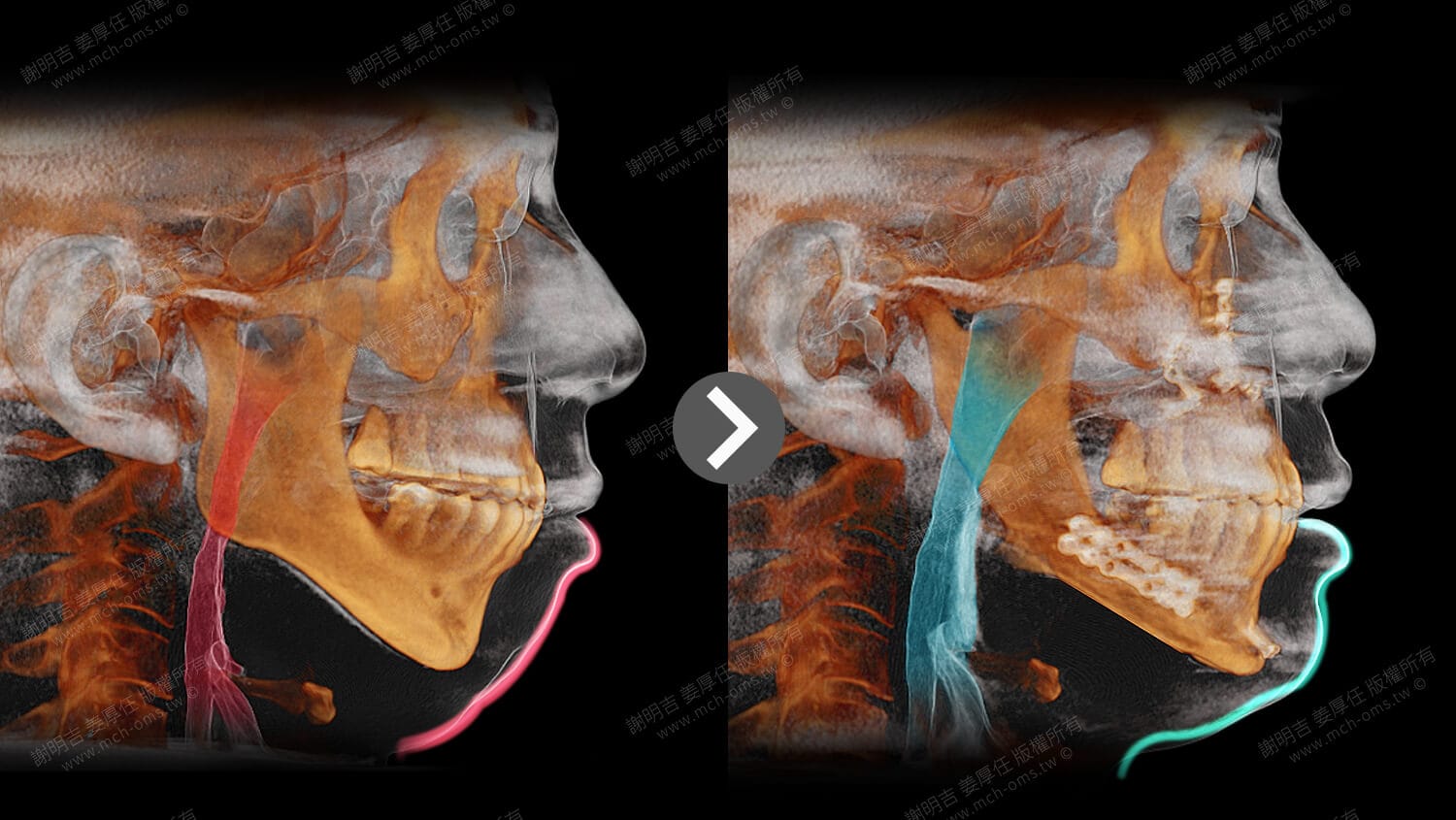
By tightening the upper airway muscles, the airway becomes stable and less likely to collapse during sleep, so it can remain open. From the patient's pre- and post-operative photos and CT scans, it can be seen that orthognathic surgery fixes the upper and lower jaws forward (away from the spine), tightens the muscles behind them, and the soft palate muscles, tongue muscles, hyoid bone, and suprahyoid muscles are also obviously pulled forward and upward, away from the posterior cheekbone. The facial lines are supported and the bite is improved.
Orthognathic surgery was originally designed to improve the patient's occlusion and appearance. However, in the field of treating obstructive sleep apnea, orthognathic surgery (maxillo-mandibular advancement/MMA) has become a means to tighten collapsed (loosened) muscles rather than the purpose itself. The improvement in appearance and occlusion has become an added value of maxillo-mandibular advancement. By tightening the upper airway muscles, the airway becomes stable and less likely to collapse during sleep, thus remaining unobstructed. From the preoperative and postoperative photos and CT scans of the patients, it can be seen that orthognathic surgery fixes the maxilla and mandible forward (away from the spine), tightening the muscles behind the upper and lower jaw bones. The soft palate muscles, tongue muscles, hyoid bone, and suprahyoid muscles are also significantly pulled forward, away from the posterior pharyngeal wall. The facial soft tissue envelope is supported, and the occlusion is also improved.


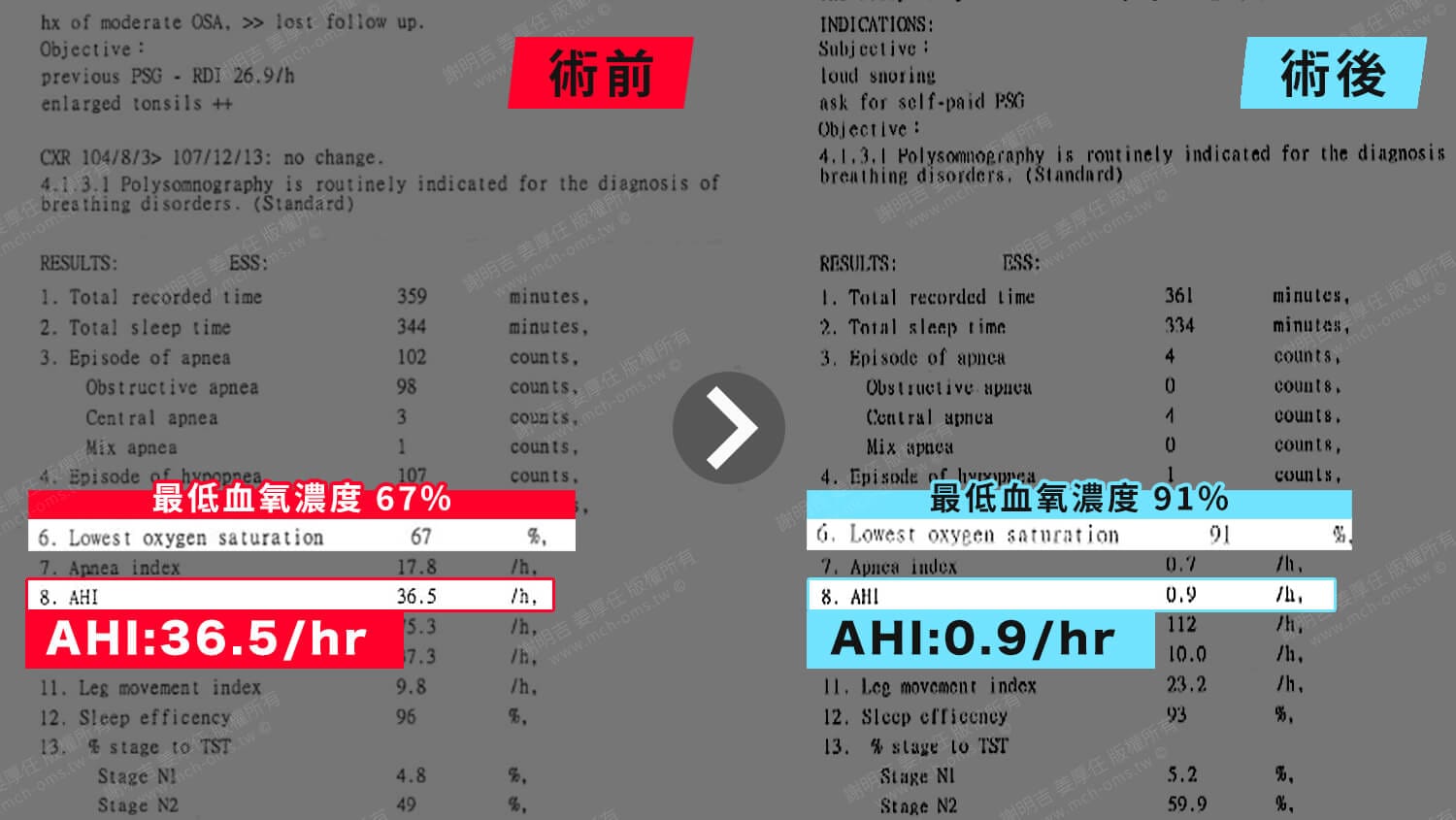
AHI (apnea index) dropped from 36.5 to 0.9 (academically, AHI below 20 indicates a successful surgery, and below 5 indicates a cured surgery), and the minimum blood oxygen concentration increased from 67% to 91%. In addition to the improvement in these sleep indicators, the most important thing is that the patients themselves feel that their sleep quality has greatly improved after the surgery. They no longer have the problem of daytime sleepiness, and they feel more energetic and energetic! ! !
The AHI (apnea-hypopnea index) decreased from 36.5 to 0.9 (defined as surgical success if AHI is below 20, and surgical cured if below 5). The lowest blood oxygen concentration increased from 67% to 91%. In addition to these improvements in sleep indicators, the most important thing is that the patient feels that the quality of sleep has greatly increased after the surgery, no longer has daytime sleepiness, and feels more energetic and vibrant!
Appearance changes